How Businesses Can Reduce Their Carbon Footprint with Smarter Lighting in 2025

Reducing your business’s carbon footprint isn’t just about meeting sustainability goals—it’s about improving efficiency, cutting costs, and staying competitive in an environmentally conscious market. One of the simplest ways to make a significant impact is through smarter lighting.

With advancements in LED technology, automation, and renewable energy integration, businesses now have more options than ever to reduce energy use and lower emissions. Here are some of the most effective ways to make the switch.

Upgrade to LED Lighting

If your business is still using fluorescent or halogen lighting, upgrading to LED is one of the easiest and most cost-effective ways to lower energy consumption. LED lights use up to 75% less energy than traditional lighting and last significantly longer, meaning fewer replacements, reduced maintenance costs, and less waste.

LEDs also produce less heat, reducing the need for additional cooling and making workspaces more comfortable. Many businesses that switch to LED lighting see an immediate drop in electricity bills, while also reducing their carbon footprint.

Implement Smart Lighting Controls

Even the most energy-efficient lights can be wasteful if they are left on when not needed. Smart lighting controls can help businesses optimise their energy use by ensuring lights are only active when necessary.

Motion sensors automatically turn off lights in unoccupied rooms, reducing wasted energy. Daylight sensors adjust brightness levels based on available natural light, preventing unnecessary overuse. Automated scheduling ensures lighting matches operational hours, eliminating energy waste after business hours.

Adding smart controls to an LED lighting system can further reduce lighting-related energy consumption by up to 50%.

Power Lighting with Renewable Energy

Switching to solar-powered lighting or sourcing electricity from renewable energy providers can significantly reduce a business’s reliance on fossil fuels. If a business owns its building, installing rooftop solar panels can provide clean, sustainable energy for lighting and other electrical needs.

For businesses that lease their premises, choosing an energy provider that sources electricity from wind, solar, or hydro can be an effective alternative. Many energy retailers now offer green energy plans that allow businesses to transition to more sustainable operations without requiring infrastructure changes. For more information on these green energy plans, visit our retail energy partner, Next Business Energy.

Choose Durable, Recyclable LED Solutions

Sustainability isn’t just about reducing energy consumption; it’s also about minimising waste. Many LED manufacturers now offer recyclable and long-life lighting solutions, helping businesses reduce their environmental impact over time.

Opting for high-quality LEDs with a longer lifespan means fewer replacements and less waste. Some manufacturers also offer modular LED lighting, where individual components can be replaced instead of the entire fixture. This reduces material waste and lowers maintenance costs in the long run.

Take Advantage of Government Incentives

Governments across Australia offer incentives to businesses that invest in energy-efficient lighting. For example, in Victoria, the Victorian Energy Upgrades (VEU) Program provides subsidies for LED lighting upgrades, covering part or even all of the installation costs in some cases.

These incentives make it easier for businesses to transition to sustainable lighting without significant upfront investment. Before upgrading, businesses should check which state or federal rebates they may be eligible for, as these programs can provide considerable financial support for sustainability initiatives.

Moving Towards a More Sustainable Future

Upgrading to smarter lighting is one of the simplest and most effective ways for businesses to reduce their carbon footprint. It lowers energy consumption, cuts costs, and supports long-term sustainability goals. Whether through LED upgrades, automation, renewable energy integration, or waste reduction, businesses that take action now will benefit both financially and environmentally.

For businesses looking to make the switch, The Green Guys Group provides tailored solutions to help reduce energy costs and improve efficiency. Contact our team to discuss the best lighting options for your business and learn how government incentives can help offset the cost of upgrading.

Call us at 1300 511 875 or email us at enquiries@greenguys.com.au to find out more.

Top LED Lighting Trends for 2025

The lighting industry is on the brink of a revolution, with LED technology leading the charge toward more efficient, sustainable, and intelligent illumination solutions. As we step into 2025, several key trends are set to redefine how businesses and consumers interact with lighting systems.

1. Smart Lighting Integration

The convergence of LED technology with smart systems is creating lighting solutions that are not only energy-efficient but also highly customisable and responsive. Smart lighting allows users to control brightness, colour, and scheduling through smartphones or voice-activated assistants, enhancing convenience and adaptability in various settings. The integration of AI-powered assistants enables the creation of personalised lighting scenes based on user preferences, further elevating the user experience.

2. Human-Centric Lighting

Human-centric lighting (HCL) focuses on aligning artificial lighting with human biological rhythms to promote well-being and productivity. By adjusting color temperatures and intensities throughout the day, HCL systems can mimic natural light patterns, supporting circadian rhythms and enhancing mood. This approach is gaining traction in workplaces and healthcare facilities, where the benefits of optimised lighting are particularly impactful.

3. Enhanced Energy Efficiency

Advancements in LED technology continue to push the boundaries of energy efficiency. Innovations such as improved phosphor coatings and thermal management are leading to LEDs that consume even less power while delivering superior brightness and longevity. These developments contribute to significant cost savings and support global sustainability efforts by reducing energy consumption and lowering carbon footprints.

4. UV-C LED Applications

The application of UV-C LED technology for disinfection purposes has gained prominence, especially in the wake of global health concerns. UV-C LEDs offer a chemical-free method to inactivate bacteria and viruses, making them valuable in healthcare settings, public transportation, and even residential use. The development of efficient and safe UV-C LED solutions is set to expand, providing new avenues for maintaining hygiene and safety.

5. Sustainable and Eco-Friendly Designs

Sustainability remains a driving force in the evolution of LED lighting. Manufacturers are increasingly focusing on eco-friendly materials, recyclable components, and designs that minimise environmental impact. The push for biodegradable lighting elements and reduced reliance on hazardous substances aligns with global environmental goals and meets the growing consumer demand for green products.

6. Advanced Dimming and Control Features

The future of LED lighting includes enhanced dimming capabilities and control features that allow for greater customisation and energy savings. Thanks to advancements in LED and driver technology, it’s becoming easier than ever to integrate LED lighting with existing lighting control systems, making upgrades seamless for businesses. These innovations provide users with the ability to fine-tune lighting levels to suit specific tasks or moods, contributing to both comfort and operational efficiency.

Lighting the Way Forward

The LED lighting landscape in 2025 is characterised by innovations that prioritise efficiency, user well-being, and environmental sustainability. From smart integrations and human-centric designs to advancements in energy efficiency and eco-friendly materials, the future of lighting is poised to enhance our environments in intelligent and responsible ways. Businesses and consumers alike stand to benefit from embracing these trends, illuminating a path toward a brighter and more sustainable future.

Ready to upgrade your lighting for 2025? The Green Guys Group is here to help your business stay ahead with cutting-edge LED solutions. Whether you’re looking to enhance energy efficiency, implement smart lighting, or explore sustainable designs, we’ve got you covered.

Call us at 1300 511 875 or explore our website to see how we can bring the latest LED innovations to your space.

Bright Ideas for Office Efficiency: LED Lighting Upgrades

Are LED Lights the Future for Offices? | Efficient Energy Group

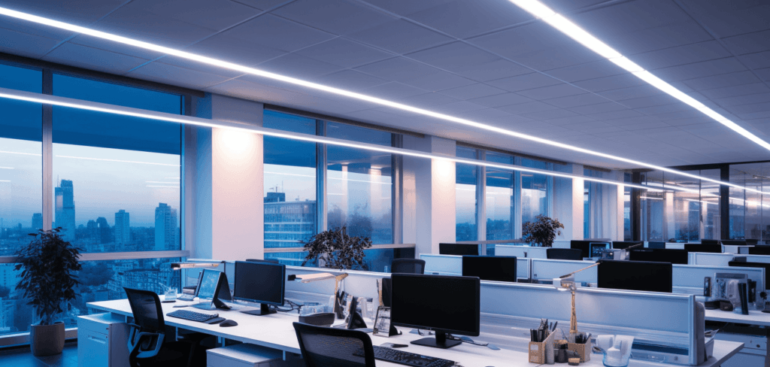
When businesses think about reducing overhead costs and improving sustainability, lighting may not always be the first thing that comes to mind. However, for offices and commercial spaces, lighting can account for a significant portion of energy use. Upgrading to energy-efficient LED lighting offers not only substantial cost savings but also better lighting quality, lower maintenance, and a reduced environmental impact. Here’s why LED lighting upgrades should be at the top of your office efficiency checklist.

1. Significant Energy Cost Savings

Traditional incandescent and fluorescent lighting systems are notorious energy guzzlers. By switching to LEDs, your office can reduce lighting-related energy consumption by up to 75%. LEDs use advanced technology to convert more electricity into light, requiring significantly less energy to operate. This translates into lower utility bills for your business and a faster return on investment.
Tip: Offices that operate for extended hours can maximise their savings by combining LED upgrades with smart lighting controls like motion sensors and timers.

2. Enhanced Lighting Quality and Productivity

LEDs produce consistent, high-quality light with minimal flicker, creating a more comfortable and productive workspace. Studies show that better lighting can improve focus, reduce eye strain, and even enhance employee well-being. Additionally, LEDs are available in a range of colour temperatures, allowing you to customise the lighting for different office areas, from bright white for meeting rooms to warm tones for relaxation zones.
Tip: Opt for dimmable LEDs and daylight-matching systems to create a dynamic lighting environment that adapts to your team’s needs.

3. Lower Maintenance and Longer Lifespan

One of the most practical benefits of LED lighting is its longevity. LEDs last up to 25 times longer than traditional bulbs, which means fewer replacements and less maintenance downtime. For businesses, this means lower operational costs and fewer disruptions.
Tip: Choose high-quality LED fixtures with warranties to ensure reliability and avoid unnecessary maintenance costs in the future.

4. Environmentally Friendly and Sustainable

Switching to LED lighting significantly reduces your office’s carbon footprint. LEDs consume less energy, produce fewer greenhouse gas emissions, and contain no harmful materials like mercury, making them easier to dispose of responsibly. By adopting LEDs, your business aligns with sustainability goals and contributes to Australia’s broader commitment to reducing emissions.
Tip: Highlight your commitment to sustainability in marketing and recruitment to attract eco-conscious clients and employees.

5. Take Advantage of Government Incentives

In Australia, programs like the Victorian Energy Upgrades (VEU) and New South Wales Energy Savings Scheme (ESS) offer rebates and incentives for businesses that install energy-efficient lighting. These programs can significantly offset the upfront costs of LED upgrades, making it easier for businesses to invest in efficiency.
Tip: Work with a trusted provider like The Green Guys Group to simplify the process of accessing these incentives. We’ll guide you through eligibility and handle the paperwork, so you can focus on running your business.

A Brighter Future for Your Office

Upgrading to LED lighting is a practical, cost-effective way to improve office efficiency, reduce energy bills, and achieve sustainability goals. With benefits like better lighting quality, longer lifespans, and access to government rebates, LED lighting is an investment that pays off in both the short and long term.

Ready to make the switch? Contact The Green Guys Group today to explore how LED lighting upgrades can transform your office space. Call us at 1300 511 875 or visit us online at The Green Guys Group to get started on a brighter, more efficient future.

5 Reasons Your Business Should Invest in Energy-Efficient Hot Water Solutions

When it comes to managing a business’s energy costs, the focus often lands on high-consumption items like lighting or HVAC systems. However, hot water is an essential utility for many sectors—from hospitality to healthcare—that often goes overlooked. Upgrading to energy-efficient hot water solutions, such as heat pump systems, can yield significant cost savings and sustainability benefits. Here’s why investing in an energy-efficient hot water system is a smart move for your business.

  1. Substantial Energy Cost Savings

Heating water is typically one of the most energy-intensive tasks for businesses, especially those in sectors like hospitality, healthcare, or manufacturing. Traditional water heating systems consume high levels of electricity or gas, adding up to substantial costs over time. By switching to an energy-efficient heat pump hot water system, your business could save up to 70-80% on hot water costs. These systems use ambient air to heat water rather than relying solely on electricity, cutting down on overall energy consumption.

Tip: Businesses can see faster ROI when they choose energy-efficient models, especially those that are eligible for government rebates.

  1. Reduced Maintenance and Replacement Costs

Traditional water heaters not only consume more energy but also require more frequent maintenance and replacement, which adds to operating costs and creates downtime. Energy-efficient heat pump systems have fewer parts that degrade with use, which means they last longer and require less maintenance. This longevity helps businesses avoid the expense and disruption of frequent replacements.

Tip: Look for a system with a warranty and reputable after-sales support to maximise long-term savings.

  1. Reliable Operation in All Conditions

One of the biggest advantages of heat pump hot water systems is their reliability. These systems do not rely on solar panels or other weather-dependent energy sources, meaning you can enjoy a steady supply of hot water regardless of weather conditions. This is particularly beneficial for businesses with high or continuous hot water demands, such as hotels or care facilities, where access to hot water is crucial.

Tip: Consult with a trusted provider like The Green Guys Group to find a system that’s optimal for your industry’s needs.

  1. Improved Environmental Impact and Carbon Footprint

Switching to an energy-efficient hot water system is not just about reducing costs; it’s also a commitment to sustainability. By choosing a heat pump, your business can significantly cut down on CO2 emissions. This not only supports Australia’s broader sustainability goals but can also help your business achieve its environmental targets or corporate social responsibility (CSR) goals.

Tip: Many clients today consider environmental impact when choosing where to spend. Highlighting your sustainability efforts can enhance your business’s reputation and attract eco-conscious customers.

  1. Access to Government Subsidies and Incentives

In Australia, numerous government programs support businesses that choose energy-efficient upgrades. Programs like the Federal Government Small-scale Renewable Energy Scheme, Victoria Energy Upgrades Program, and New South Wales Energy Savings Scheme provide subsidies and rebates for eligible upgrades. By choosing a heat pump system, your business could offset a significant portion of the installation costs.

Tip: Partnering with an accredited and long-standing provider like The Green Guys Group simplifies the process, as we guide you through eligibility requirements and handle the necessary paperwork.

A Hot Water Solution for Sustainable Growth

Investing in an energy-efficient hot water system is an opportunity for businesses to lower costs, reduce their carbon footprint, and improve their operational efficiency. With benefits like reduced energy and maintenance costs, reliable operation, and access to government rebates, it’s clear that a heat pump hot water upgrade offers substantial long-term value.

Ready to make the switch? Contact The Green Guys Group today to explore our energy-efficient hot water solutions and learn how we can help your business achieve both financial and environmental benefits. Call us at 1300 511 875 or visit us online to get started on your path to sustainable growth.

Why Choosing the Cheapest LED Lighting Upgrade May Cost You More in the Long Run

When considering an LED lighting upgrade, it’s natural to gravitate toward the lowest-cost option. Studies even show that, when faced with multiple choices, people often choose the least expensive option. However, when it comes to LED lighting, choosing the cheapest proposal may lead to costly consequences, as low-quality products can compromise lighting quality, reduce efficiency, and require frequent replacements.

The LED market today is saturated with a wide range of products, and not all are created equal. Cheaper options may save you upfront, but they often come from lesser-known or unreliable manufacturers. This lack of quality control can lead to poor lighting performance and a short lifespan, ultimately costing more in replacement and maintenance over time.

1. Poor Lighting Quality: The CRI Factor

One of the key indicators of lighting quality is the Colour Rendering Index (CRI), which measures how accurately a light source represents colours compared to natural sunlight. High-quality LED products generally have a CRI of 80 or above, providing better colour fidelity and making spaces appear more vibrant and true-to-life. LEDs with lower CRI values may distort colours, giving spaces a dull or unnatural appearance.

Unfortunately, many low-cost LED products sacrifice CRI to cut costs, focusing solely on energy efficiency. These products may not display CRI values prominently, leading customers to unwittingly compromise on lighting quality. In some cases, users find the quality so poor that they revert to traditional incandescent or halogen lighting, which has a CRI of 100, despite its higher energy consumption.

Tip: Always check the CRI rating when purchasing LEDs. For most applications like offices, schools, and warehouses, a CRI above 80 is the industry standard. However, environments demanding precise colour accuracies, such as hospitals (especially surgical areas), high-complexity manufacturing facilities, art studios, and printing presses, should opt for LED products with a CRI above 90.

2. Questionable Service Life Claims

One of the biggest benefits of LED lighting is its longevity. High-quality residential LEDs often last 25,000 hours, and commercial-grade LEDs can exceed 50,000 hours. Reputable manufacturers rigorously test their products following industry standards like LM-80 and TM-21, which are used to measure and project the lifespan of LED lighting systems, to ensure they meet these lifespan claims.

However, lower-priced LEDs may skip these rigorous testing processes, and their labels may boast an inflated lifespan. In reality, these cheap LEDs might fail within months, undermining any initial savings. Frequent replacements quickly add up, making these products far more expensive over time.

Tip: Look for products from manufacturers that openly share testing standards and provide a warranty. A trusted brand’s warranty can serve as an indicator of quality and reliability.

3. Limited Warranty or Lack of Support

Reliable LED manufacturers typically offer warranties on their products, providing assurance against premature failures. Cheap LEDs, on the other hand, often come with minimal or no warranty, leaving customers to bear the replacement costs if the product doesn’t last. A warranty is more than a promise; it’s a safeguard against defective products and a sign that the manufacturer stands by their quality.

Tip: Opt for products with warranties that cover at least 5 years. This helps protect your investment and gives you peace of mind.

4. Missing Out on Government Rebates

Many businesses are eligible for government rebate programs when they upgrade to energy-efficient lighting. However, to qualify, you often need to meet certain standards or use approved products. Low-cost LED products may not meet the criteria for these rebate programs, potentially missing out on substantial savings.

Tip: Consider partnering with a provider that can guide you through rebate eligibility. By choosing quality LED products, you may be able to recoup a portion of your investment through government incentives.

Invest Wisely for Long-Term Gains

Upgrading to LED lighting is an investment, one that can yield significant energy savings and lower operational costs over time. However, not all LED products offer the same value. By choosing high-quality products from reputable manufacturers, you’ll not only enhance your space with better lighting but also reduce the likelihood of premature replacements and unexpected expenses.

In Summary:

  • Choose LEDs with a high CRI (80+) for better lighting quality.
  • Confirm that the manufacturer has conducted lifespan testing.
  • Prioritise products with a solid warranty.
  • Look into government rebates to maximise your savings.

A smart lighting choice today can bring long-term efficiency, lower costs, and better lighting quality for years to come.

Ready to upgrade your lighting? Contact The Green Guys Group or call us at 1300 511 875 to explore quality LED solutions, and let us help you maximise savings through energy-efficient lighting and available rebates. Illuminate your business sustainably—reach out today to start your energy transformation!